Most homeowners want to know the duration of a paint job for practical reasons: how long the furniture is stacked in the middle of the room, when the scaffold comes down, whether they need to rearrange the school run. The trouble is that "how long does it take to paint a house" has no single answer, because the same square metreage can take four days or fourteen depending on preparation, access, weather and coat count. This guide gives you realistic timelines, walks through what actually happens on each day, and flags the delays that catch people out.
Quick reference: typical durations
These figures assume a professional crew of two to three, standard preparation on a repaint, and two topcoats. They are working days, not calendar days, so a nine-day job will usually span roughly two weeks.
| Scope | Small home | Average home | Large home |
|---|---|---|---|
| Single room, walls and ceiling | 1 day | 1–2 days | 2 days |
| Full interior, walls and ceilings | 3–4 days | 5–7 days | 8–12 days |
| Full interior including all trim and doors | 4–6 days | 7–10 days | 10–16 days |
| Exterior, single storey | 3–4 days | 4–7 days | 7–10 days |
| Exterior, double storey | 5–7 days | 7–12 days | 12–18 days |
| Roof restoration and coating | 2–3 days | 3–5 days | 5–7 days |
| Whole property, inside and out | 8–12 days | 12–20 days | 20–30 days |
What happens day by day on an interior repaint
Here is how a typical five to seven day interior job on a three-bedroom Sydney home unfolds. The exact order shifts depending on the house, but the sequence logic rarely changes.
Day 1: protection and preparation
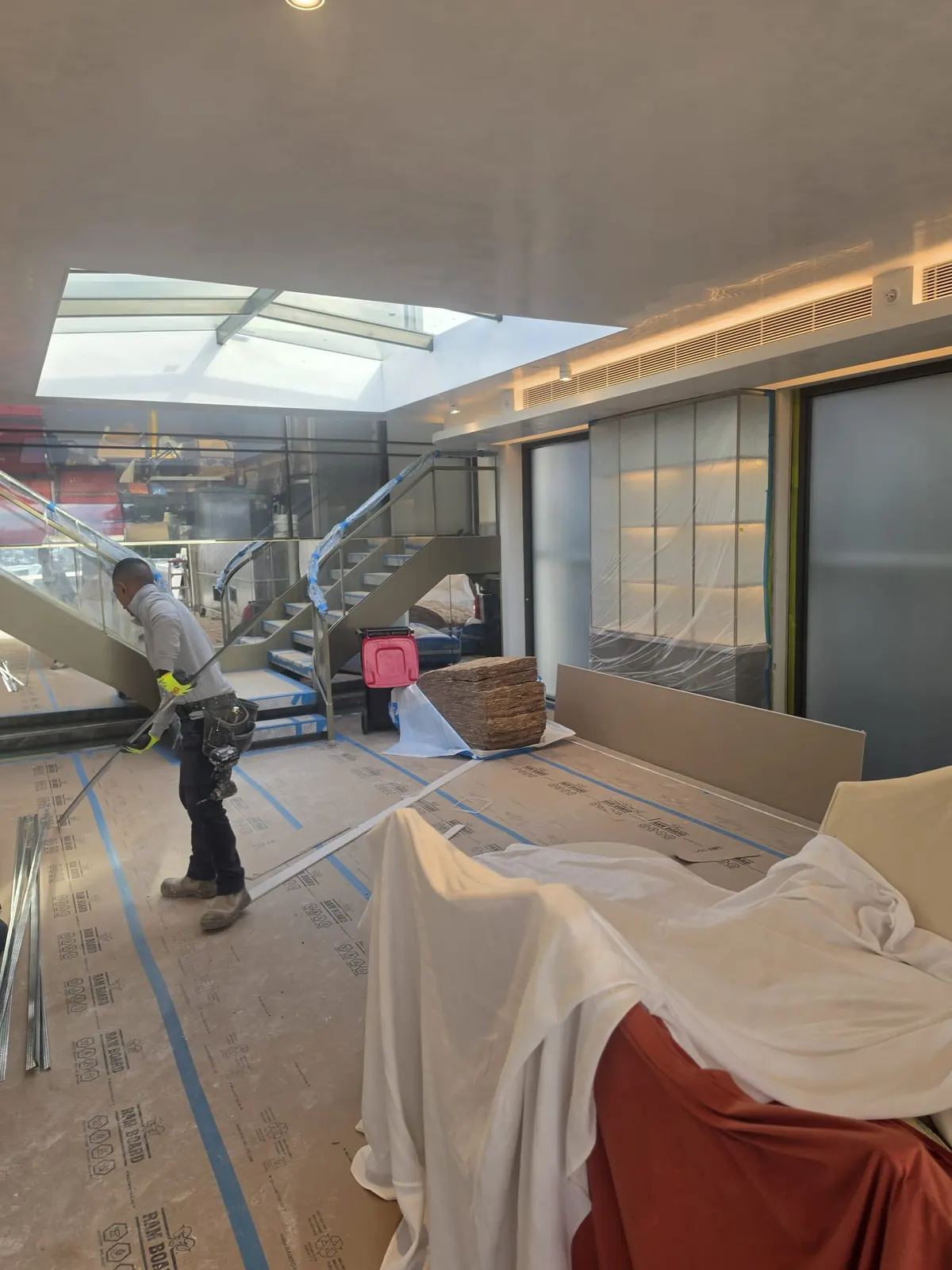
Drop sheets down, furniture moved to the centre and covered, floors protected, power points and fittings masked. Then the unglamorous part: filling nail holes and cracks, sanding back rough patches and flaking areas, caulking gaps between skirtings and walls, treating any mould. Almost no paint goes on the walls on day one and that is entirely normal.
Day 2: spot priming and ceilings
Patched areas get sealed so they do not flash through the topcoat. Water stains get a stain-blocking primer. Ceilings usually go first because overspray and drips fall downward, and doing them before the walls means any splatter gets covered later.
Days 3–4: wall coats
Cutting in around the edges with a brush, then rolling the main field. First coat across all rooms, then a return for the second coat once the first has dried properly. On an average home this is where the bulk of the visible progress happens.
Days 5–6: trim, doors and detail
Skirtings, architraves, window frames and doors. This is slow, brush-heavy work and enamel needs long drying windows, which is why trim is almost always the tail end of an interior job rather than the start. Doors often need to be left open overnight to cure without sticking.
Day 7: touch-ups and handover
A walk-through in good daylight, marking and fixing any misses, removing masking, reinstalling fittings, moving furniture back and a final clean. A painter who skips the walk-through is skipping the part where small defects get found. Our full interior painting process follows this sequence on every job.
Exterior timelines and why they run longer
Exteriors take longer per square metre than interiors, and the reason is preparation. Before any coating goes on, an exterior typically needs pressure washing to remove dirt, chalking and mould, then time to dry. Loose and flaking paint has to be scraped back, bare timber spot-primed, gaps and joints re-caulked, rust on metalwork treated, and rotten sections of weatherboard or fascia repaired or replaced.
On a weatherboard home, that preparation stage alone can occupy half the total job. Rendered and face brick surfaces are considerably faster, which is why two homes of identical size across the same Sydney street can differ by four or five days. Add scaffold or elevated work platform setup on a double-storey, and access equipment becomes its own line item in the schedule. Our page on exterior painting and protection covers the surface-by-surface differences in more depth.
Roofs are their own timeline
A roof restoration is not just a coating job. It usually involves a high-pressure clean, repointing or rebedding ridge capping on tile roofs, replacing broken tiles, treating rust and priming on metal roofs, then a primer and two coats of membrane. Three to five days is common, and the whole thing lives or dies on the weather. Read more about the process on our roof painting and restoration page.
What makes a job take longer
- Preparation the previous painter skipped. Old paint that was applied over dirty or unprimed surfaces will be lifting, and all of it has to come off. This is the single most common reason a job runs over.
- Timber repairs. Rotten weatherboard, fascia or window sills found during prep need replacing before coating, which can add days.
- Colour changes. Going pale over dark, or dark over pale, frequently needs an extra coat. We go into the technique in our guide to covering dark walls efficiently.
- High or raked ceilings and stairwell voids. Platform setup, moving and resetting adds hours that flat ceilings do not.
- Occupied homes. Working around people, pets and furniture is slower than working in an empty house, sometimes by 20 per cent or more.
- Strata and access rules. Apartments and townhouses often have restricted working hours, lift bookings and common-property approvals that compress the working day.
- Weather. Covered separately below, because in Sydney it deserves its own section.
How Sydney weather affects the schedule
Sydney's climate is generally kind to painters, which is why so much exterior work happens here year round. But it has quirks worth planning around.
- Summer heat. On days above the mid-30s, paint can skin over before it levels, leaving roller marks and lap lines. Crews often start at dawn and chase the shade around the house, which shortens the productive day.
- Humidity. Sydney summers are humid, and high humidity slows drying substantially. A coat that would recoat in three hours in April might need six in February.
- Rain. Not just the rain itself. Render, timber and masonry hold moisture, so a heavy weekend can put an exterior job back two or three days while surfaces dry out enough to coat.
- Winter mornings. Cool overnight temperatures and morning dew mean exterior work often cannot start until mid-morning through June and July, and has to stop earlier in the afternoon.
- Coastal conditions. Homes near the water across the eastern and northern beaches carry salt deposits that must be washed off thoroughly, adding a prep step that inland properties do not need.
Our separate article on the best time of year to paint a Sydney exterior goes into the seasonal trade-offs in more detail.
Drying times: the constraint nobody can rush
You can add painters to a job to speed up application. You cannot add painters to make paint dry faster. Recoat times are a hard floor on any schedule.
| Product type | Touch dry | Recoat | Full cure |
|---|---|---|---|
| Water-based wall paint | 30–60 min | 2–4 hours | 2–4 weeks |
| Ceiling flat | 30–60 min | 2 hours | 2 weeks |
| Water-based enamel (trim) | 1–2 hours | 4–6 hours | 4–6 weeks |
| Oil-based enamel | 4–8 hours | 16–24 hours | 6–8 weeks |
| Exterior acrylic | 1–2 hours | 4–6 hours | 4 weeks |
| Roof membrane | 1–2 hours | 4–8 hours | 4–6 weeks |
Full cure matters more than people expect. Paint is touch dry in an hour but does not reach its final hardness for weeks. That is why we ask homeowners not to scrub freshly painted walls or push furniture hard against skirtings for the first month. Choosing the right product for the surface makes a real difference here, and our materials guide explains which systems we use where.
How to keep your painting job on schedule
- Choose colours before the crew arrives. Indecision at the tinting stage is a surprisingly common cause of lost days.
- Clear rooms in advance. Every hour the painters spend shifting your furniture is an hour not spent painting.
- Sort repairs first. If a gutter leaks or a window frame is rotten, fix it before painting rather than discovering it mid-job.
- Agree access early. Keys, alarm codes, side gate, pets, parking. A crew locked out for an hour each morning loses half a day across a week.
- Book realistically. Aim for exterior work in autumn or early spring rather than the peak spring rush or the wettest stretch of summer.
- Read the preparation checklist. Our post on getting your home ready for the painters covers exactly what helps.
Frequently Asked Questions
How long does it take to paint a whole house interior?
A typical three-bedroom home with walls, ceilings and trim usually takes a two to three person crew about five to eight working days. A larger four or five bedroom home commonly runs eight to twelve days. Extensive patching, high ceilings and heavy trim work add time more than floor area does.
How long does exterior house painting take?
Most single-storey exteriors take four to seven working days and double-storey homes seven to twelve, assuming stable weather. Rendered and brick surfaces move faster than weatherboard, which needs more preparation and usually more coats on the timber.
Can I stay in the house while it is being painted?
Yes, for almost all exterior work and for most interior jobs. Painters generally work room by room so you always have usable space. Low-VOC water-based paints mean odour is mild, though you may prefer to sleep elsewhere on the night a bedroom is coated.
How long does paint take to dry between coats?
Water-based wall paint is usually touch dry within an hour and ready to recoat in two to four hours in mild conditions. Oil-based and water-based enamels on trim need considerably longer, often overnight. Cold or humid weather can easily double these times.
Does rain delay exterior painting?
Yes. Surfaces must be dry before coating and fresh paint needs several hours without rain to cure properly. After significant rainfall, external timber and render often need a day or more to dry out, so a wet week can push an exterior job back well beyond the rain itself.
Why does preparation take so long?
Preparation is typically 40 to 60 per cent of the total hours on a repaint. Washing, scraping, sanding, filling, caulking and priming all have to happen before the first topcoat, and each step determines how long the finish lasts. It looks slow because it is the part that does the real work.
Is it faster to spray than to roll?
Spraying applies paint much faster, but the masking required to protect everything nearby often cancels most of the saving on an occupied home. Spraying makes the most sense on empty properties, new builds, roofs and large uninterrupted exterior surfaces.
How far ahead should I book a painter in Sydney?
Two to six weeks is typical, and spring is the busiest period across Sydney as homeowners rush exterior work before summer. Interior jobs in autumn and winter usually have shorter lead times, which is a reason to schedule inside work in the cooler months.
A timeline you can actually plan around
The most useful thing a painter can give you is not the shortest number, it is an accurate one. We would rather tell you a job is nine days and finish in nine days than promise five and leave your furniture stacked in the hallway for a fortnight. When we quote, we walk the property, flag the repairs we can already see, and build the drying windows and likely weather into the schedule up front.
Want a realistic timeline for your home? Get in touch for a free quote and we will give you a day-by-day plan alongside the price. Managing a shop, office or strata property instead? Our commercial painting team regularly works after hours and on weekends to keep disruption to a minimum.